
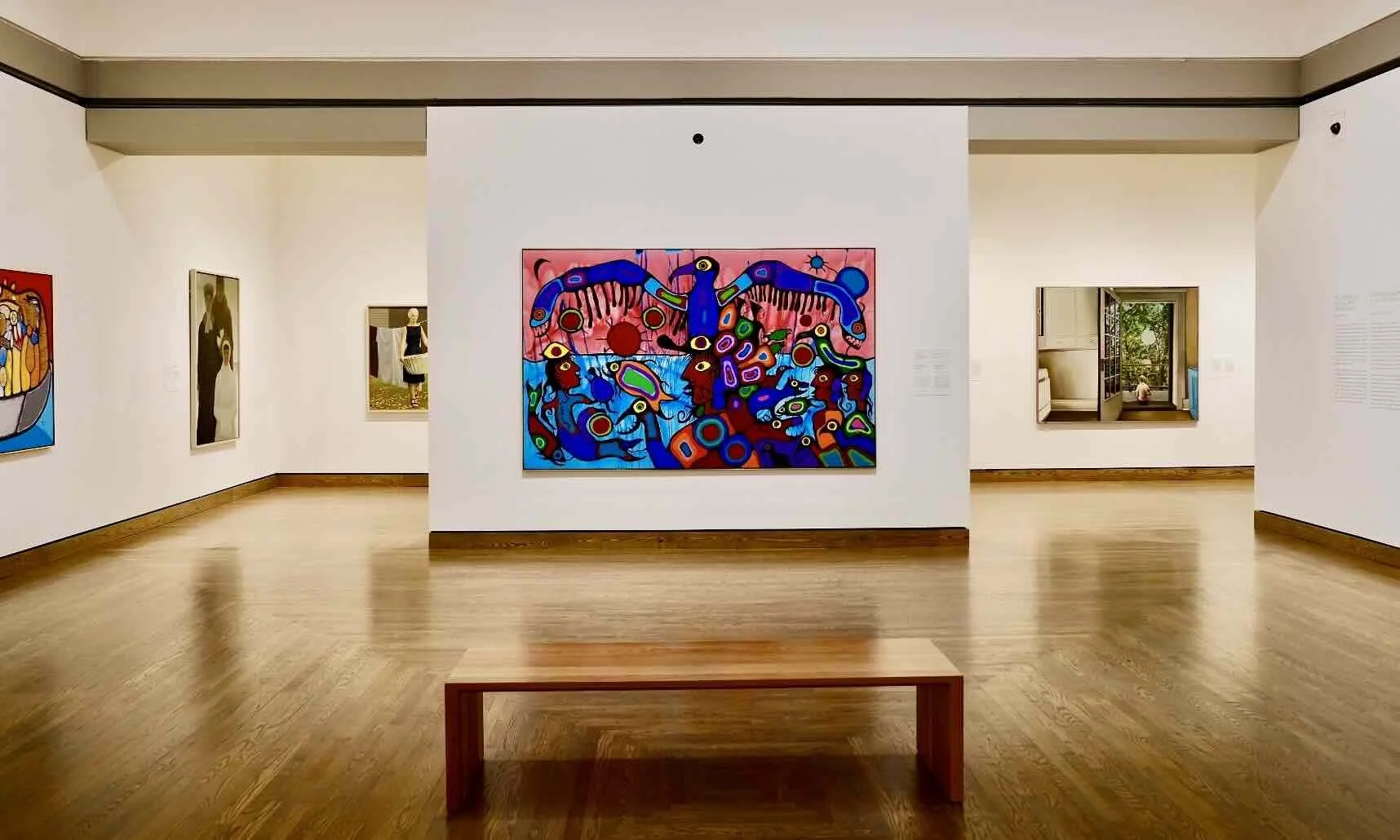
Norval Morrisseau’s “Artist and Shaman between Two Worlds” (1980), photograph courtesy of Joanne Clifford via Wikimedia Commons, reproduced under a CC BY 2.0 license.
.jpg)
As a federal prosecutor and later as the head of compliance for a major auction house, I’ve seen how art forgery schemes can wreak havoc in the market, cause substantial loss and pain to victims, and do significant damage to the historical record. I have been reading with great interest about the successful takedown of the sprawling, long-running forgery schemes that produced thousands of forged works attributed to Indigenous Canadian artist, Norval Morrisseau (1932–2007). The November 2025 conviction of the last of six defendants charged in the scheme was hard fought and long coming. The staggering scale and extent of the damage done to victims of the fraud, to others caught up in it, to the spiritual integrity of the Indigenous culture that Morrisseau celebrated in his art, and to Morrisseau’s legacy as Canada’s most revered Indigenous artist, is disturbing and heart breaking. At their peak, multiple forgery networks produced thousands of counterfeit paintings, flooding the market with works accompanied by forged certificates of authenticity and fabricated backstories that deceived collectors, dealers, and reputable galleries and institutions.
Few cases in modern art history have exposed the limits of trust, science, and paperwork quite like the Morrisseau forgery scandal – yet it followed many familiar and recurring patterns. The scheme unraveled finally under the weight of a multi-faceted approach combining scientific forensic testing, with provenance research and due diligence into the documents and people standing behind the works, connoisseurship, and investigative persistence. I will examine what ultimately exposed the deception in order to provide insights into how it might have been prevented – and consider what lessons can be learned from this complex art fraud.
Norval Morrisseau: Background and Career
Morrisseau is perhaps the most important modern Indigenous artist in Canada and beyond; Marc Chagall reputedly labeled him the “Picasso of the North.” Morrisseau founded the Woodland School of Art, which melded images drawn from his Anishinaabe spiritual traditions and oral myth with “western” influences, to create a unique, new, pathbreaking artistic form.
Morrisseau was raised on an Anishinaabe reserve near Thunder Bay. At age 6, Canadian officials forced Morrisseau to leave home and attend a residential boarding school, where he stayed for approximately four years. There, along with other Indigenous youth, he was effectively denied access to his culture, family, and traditions, in the name of “assimilation.”
In 1962, Morisseau became the first Indigenous painter to have his work displayed in a contemporary Canadian gallery. That exhibition, hosted in Toronto, also marked the artist’s breakthrough into the mainstream. Morrisseau continued to delve into his Indigenous identity even as he achieved notoriety in the art scene, became a practicing shaman, and began signing his paintings with the name Copper Thunderbird, given to him as part of a healing ceremony.
Morrisseau’s life had its ups and downs. He struggled with alcoholism and while he achieved a degree of financial success, he was erratic and unpredictable in how he handled money and attention. It was not until later in life that Morrisseau became increasingly distressed about the appearance of fakes and forgeries of his work in the market. He started sending letters and affidavits to galleries and collectors when he spotted fakes in their inventory and worked with experts to create an authentication body. Sadly, Morrisseau passed away in 2007 before he could see justice done to the forgery-ring kingpins he fought so hard against. Morrisseau’s work is internationally renowned and has been exhibited worldwide. The lasting damage done to his legacy from the forgery schemes – and the degree to which the market and historical record can be restored now that the schemes have been terminated – is still in question.
A Rock Star, Art Purchaser, Victim and Hero
Kevin Hearn is a musician for the Canadian rock band The Barenaked Ladies (think theme song for The Big Bang Theory). In May 2005, Hearn purchased what he believed was a genuine Morrisseau painting from the Maslak-McLeod Gallery in Toronto. He was aware that there were issues in the market concerning authenticity of Morrisseau works. However, he approached the purchase as so many in the art market do: relying on the dealer, accepting the provenance information the dealer provided to him at face value without asking for back-up or substantiation, and conducting no independent due diligence. Hearn completed the transaction and bought a painting called Spirit Energy of Mother Earth for $20,000 Canadian dollars.
The details of Hearn’s journey following this acquisition provide a fascinating tutorial on how to approach authenticity when buying a work of art. Many people think of an artwork’s authenticity as a matter to be definitively decided by physical and scientific testing. There is also a perception that scientific or forensic examination is prohibitively expensive and possibly damaging to the work itself.
To be sure, scientific testing can be costly, but readers should also know that not all scientific testing entails expensive equipment or invasive techniques. While microscopic samples sometimes need to be taken, that is not always the case and the samples can be so tiny that they are not visible to the naked eye or under a microscope. ArtRisk Group co-founder Jim Wynne and I have worked on forgery matters where examination of a canvas under a simple ultraviolet blue light – the kind used in the 1980s as a disco ball – revealed suspicious under-drawings entirely inconsistent with the artist’s other work and known techniques. But the Morrisseau and many other forgery schemes teach us that forensic analysis can be a small, inconclusive part of the puzzle. The reason the Morrisseau forgery rings crumbled was primarily the exposure of a myriad of collateral lies about provenance and other false representations about the works’ origins, many of which could have been exposed early on with more aggressive due diligence. Scientific testing no doubt played a role, but not the central one.
At the time of sale, the gallery provided Hearn with a provenance statement that listed three prior owners — supposedly private collectors — through whom the painting had allegedly passed before arriving at the gallery. The individuals were identified by name only, with no contact information, acquisition dates, supporting documentation, or references to exhibitions, publications, or known institutional collections. The dealer assured Hearn that his painting was indeed an authentic Morrisseau. Hearn accepted this representation and trusted the dealer.
That was fine for about five years, In June 2010, however, Hearn got the crushing news that the Art Gallery of Ontario (AGO) had removed his painting from an exhibition after concluding it was a fake. Hearn immediately went back to the gallery demanding assurances. What he got was astonishing – a new, “improved”, expanded provenance statement.
This second provenance document changed material details:
It altered the listed prior owners — dropping one name and substituting others.
It added references to an intermediary collector who supposedly had close ties to Morrisseau.
It introduced vague claims about the painting’s “exhibition history” and connection to Morrisseau’s circle, but still without verifiable dates, galleries, or documentation.
It included new language asserting that the work had been “authenticated by the artist” and carried the “correct signature and style.”
The dealer no doubt thought this would assuage Hearn, but it had the opposite effect. This time around, Hearn was not accepting or trusting anything and instead conducted due diligence and attempted to trace the names and transactions. Not one of them could be verified. Some of the listed collectors were indeed known to be prolific Morrisseau collectors, and thus it was credible to see their names listed in the ownership chain. However, these collectors, when contacted, freely revealed they had never seen or handled the Hearn painting. One of the listed collectors was a fabricated person who did not exist.
The tactic of fabricating provenance with plausible names and exhibitions, especially when delivered with assurances from a dealer, is common across many forgery schemes. Jim Wynne and I investigated a massive forgery scheme involving Impressionist paintings that was sustained for years because the perpetrator had purchased authentic works at auction and was thus the buyer of public record and had invoices to prove it; the fake copies he produced of the works he actually purchased were sold to unsuspecting buyers with a provenance that was extremely credible.
Other notorious forgery schemes involved the same technique. For example, in the Knoedler Gallery scheme, the provenance of the forged works came from a mysterious – made-up – person referred to as “Mr. X”. It is always a red flag when the dealer refuses to identify a person in the provenance; even where confidentiality is legitimately an issue, there are numerous ways to disclose this critical information securely. To lend credence to the “Mr. X” story, the Knoedler manager added into the mix a claim that Alfonso Ossorio, a real person who may well have known and interacted with the artists, had “brokered” the purchases to “Mr. X.” Similarly, the so-called “Matter Pollacks” were “discovered” in an East Hampton storage facility, giving rise to a backstory of plausibility, given that Jackson Pollack had, in fact, famously lived and worked in East Hampton. Jim Wynne handled another case involving de Kooning fakes where the forgeries were also “discovered” in the Hamptons near where de Kooning had, in fact, painted. Forgery schemes frequently employ the tactic of dropping into the provenance something that has a grain of truth to bolster the credibility of otherwise completely fabricated histories, and to deter buyers from probing more deeply. The Morrisseau forgery rings used these techniques – although underneath the veneer was nothing more than an abundance of plain lies and made-up ownership history.
We can only speculate about whether things would have gone differently if, at the time of the 2005 purchase, Hearn had pressed the dealer for more information about the collectors, or, for that matter, had pressed for more details of any kind. Perhaps independent internet research would have uncovered the irregularities and caused Hearn to look twice. This is not to cast blame on Hearn, and in fact the litigation he later pursued confirmed that he reasonably relied on the false representations about authenticity he received from the dealer. Nonetheless, a favorable judgment at the end of a protracted and expensive litigation is not what most art buyers want. Forgery, by definition, comes with a false provenance because the work is not what it is held out to be. Especially when forgery issues have already surfaced with respect to the artist in question, it is always a good idea and best practice to ask for substantiation and engage in further checking and verification.
The Limits of Science Alone
Hearn ultimately sued the gallery. However, the trial court missed the crucial issue.
The judge thought of his role as that of art authenticator, and lost sight of his job to decide the legal issue of whether the dealer had made knowingly false and/or reckless misrepresentations to Hearn about the authenticity of the painting. This misstep took the court down a rabbit hole of trying to make sense of competing forensic experts, both sides producing contrasting scientific analyses — pigment dating, ultraviolet fluorescence, and material comparisons. Caught in the crossfire of opposing experts, the judge found the scientific evidence to be “even,” meaning neither side had definitively proved or disproved authenticity on scientific grounds, and concluded that Hearn hadn’t met the burden of proof on the specific painting he had purchased.
The story might have ended there. But Hearn had the resources and the will to keep pressing. He appealed the decision and won. The appellate court recast the question as whether the gallery made a false or reckless representation of authenticity, not whether Hearn could scientifically prove that the work was a forgery. Focusing on the provenance lies rather than the forensic analysis, the appellate court noted that the 2005 provenance had come with no substantiation and was indeed false; that the Gallery also had direct knowledge that Morrisseau forgeries were circulating in the market; and that the materially altered and false “second” provenance document was damning and “went directly to the falsity of the gallery’s representation.” On appeal, the Gallery owner was held liable for negligent misrepresentation for holding himself out as a Morrisseau expert and selling Morrisseau’s work without verifying any of the provenance or addressing the known “red flags” about authenticity.
The arc of this litigation reminds us that while scientific testing and techniques of analysis have made unimaginable strides in recent years and have been indispensable to exposing many forgeries, including many of the Morrisseau fakes, the temptation to rely on scientific testing alone, as did the trial judge, risks losing the big picture. A fake work will come with a fake history. Testing the provenance, the story of how the work was created and where it has been since creation, fills in critical gaps that help us understand and interpret the scientific results. Where it may not be practical to conduct forensic examination on a work prior to acquiring it, there is typically no obstacle (least of all cost) to asking questions about provenance, requesting more details and verification regarding exhibition history, or even suggesting a phone call with authenticators. If there exist known, pre-existing concerns about forgeries, then dealers and galleries should be receptive to such requests for due diligence, and resistance could itself be a warning sign.
Forgery Is a Crime
We now know that the Morrisseau forgery scandals went beyond negligent and reckless dealers not doing their homework or lying to buyers about ownership history. The criminal investigations into Morrisseau fakes exposed multiple layers of criminal fraud involving a horrifying mixture of deception, deceit, violence, and the exploitation of artists.
Investigations had been opened in or around 2008 but were not progressing or were closed for lack of evidence. The release of the documentary film, There Are No Fakes, which Hearn supported, was a turning point that inspired Detective Jason Rybak of the Ontario Provincial Police, working with the Thunder Bay Police Department, to open a large criminal investigation, which eventually resulted in eight arrests and the seizure of thousands of fake Morrisseau works. Many believe the magnitude of the crimes has irrevocably damaged Morrisseau’s legacy and contributed to further exploitation and damaging misappropriation of Indigenous culture.
How does forgery evolve from a civil matter into a criminal prosecution? Evidence of intent and knowledge is needed to prove a criminal art forgery case, yet my prosecutorial experience has taught me that this is very hard to amass. Hearn’s civil lawsuit against his dealer turned on the lower legal standard of “negligence.” But to prove that a dealer knew the work was fake and wasn’t “merely” breaching a duty of care, it can be necessary for the investigators to amass mountains of evidence and even find the artists who made the fakes as well as supporting cast members who produced false certificates and documentation attesting to authenticity.
Jim Wynne and I know from experience the value of tracing forged works back to the artists who made them. In one case in 2004, we had collected persuasive evidence against a dealer under investigation, but, mindful that the criminal standard is “beyond a reasonable doubt,” we were searching hard for evidence that would specifically convince a jury that the dealer knew the works were forged. We had evidence that the dealer had exploited highly skilled artists who he sponsored through work VISAs to come to the United States from abroad, and we suspected that he was exerting his leverage over them to coerce them into creating identical copies of works in his inventory. Jim’s dogged and skillful investigation lead him to two of the artists involved in the scheme – both of whom had photographed themselves making the copies so they would have documentation to show the authorities one day. This provided incontrovertible evidence connecting the dealer to the production and sale of forgeries and was likely a major reason the dealer pleaded guilty and was sentenced to three years in prison.
That kind of direct evidence was crucial for securing a criminal conviction in the case of one of the Morisseau forgery rings. Gary Lamont, a Thunder Bay man linked to drug dealing and violence, founded and operated a Morrisseau forgery sweatshop factory. Similar to the case Jim and I handled, Lamont exploited vulnerable artists; he supplied Morrisseau’s nephew with drugs in exchange for creating fake Morrisseau works. He also coerced young Indigenous students, who were boarding at Lamont’s Thunder Bay camp with sponsorship from a Canadian government program, to assist him in creating and trafficking the forged works. Lamont exerted pressure over the young Indigenous students and others boarding at his camp using physical and sexual abuse. Statements and admissions from artists and other abuse victims of Lamont’s forgery sweatshop were overwhelmingly persuasive of criminal – not simply negligent – conduct. Lamont ultimately pleaded guilty to both sexual assault and forgery and fraud charges and was sentenced to a term of five years’ imprisonment in December 2023.
Provenance as a Crime Scene
2023 also saw the arrest of the ringleader of the most prolific Morrisseau forgery scheme, one David Voss. Detective Ryback estimated that Voss was responsible for the introduction into the market of between 4,500 to 6,000 fake Morrisseau works. The distinguishing feature of Voss’s operation, which started in the late 1990s, was the “assembly line” production of fakes. Voss would draw pencil outlines on canvas and then had a stable of painters he employed to fill in the blanks according to a “color by number” coding system. Other typical aspects of Morrisseau’s works would be added, including Morrisseau’s Cree signature, “Copper Thunderbird”. Voss also invented a new Morrisseau signature for the purpose of convincing people of authenticity, consisting of a black dry-brush English lettered signature on the back of the canvas accompanied by a legal “copyright” symbol.
Voss trafficked the mass-produced forgeries across Canada, using various overlapping provenance stories to explain his endless inventory, including that he had acquired works directly from Morrisseau himself, or that Morrisseau created hundreds of works during a six-month sentence served in 1970 in a Kenora jail where he “gave” them to Voss’s father, who worked as a prison guard there. The forgeries went into the hands of auctioneers and re-sellers, who for years persisted in claiming to believe Voss’s story and that the works were genuine.
The cover stories were plainly incredible. While it is possible that some people handled the fakes in good faith, the subsequent criminal investigation uncovered many people who clearly knew they were passing off fakes and telling lies. The criminal defendants knew Voss was linked to drug dealing and had no known relationship to the art world. The Kenora jail story provided a veneer of credibility, because Morrisseau did in fact serve a sentence there and was known to have created some paintings during that time. However, an internet search or inquiry into public source material would have revealed that Voss’s father had never worked in Kenora as a prison guard. Nor is it believable or even feasible that Morrisseau painted hundreds of works while in prison for a few months, as people close to Morrisseau freely pointed out. And crucially, the invented English-language signature complete with copyright symbol on the back of the canvas was a dead giveaway – Morrisseau never applied any such signature to the back of his works, and the most basic inquiry would have called the works’ authenticity into question.
The sudden “discovery” or appearance in the market of an unusual number of an artist’s previously undocumented works is one of the most common red flags, warranting extra caution and due diligence. Sure, this happens every once in a while, and there are genuine instances involving long-lost artworks that had been hidden away in an attic, or owned by people unaware of the artwork’s true creator. But Voss’ possession of hundreds of previously undiscovered Morrisseau paintings, all from the 1970s, that miraculously appeared decades after their alleged creation, just did not add up. Any large number of “new” discoveries should be examined and scrutinized with the greatest care. And this is especially true where forgery concerns are already on the radar, as was the case with Morrisseau.
Voss also bolstered his “paint by number” fakes with fraudulent certificates of authenticity. Such certificates were central to a third prong of the criminal scheme, and resulted in charges against two professed “art appraisers” who fabricated certificates of authenticity for Morrisseau works they knew or suspected to be forged. The fake certificates were at times accompanied with embossed seals and signatures purporting to be from the “Estate of Norval Morrisseau” or the “Morrisseau Foundation.” The tactic of enlisting alleged “independent” experts to vouch for a work’s authenticity and creating collateral documentation such as certificates and “seals” designed to convince buyers is one we see in many forgery schemes, including those investigated by myself and Jim. We recommend always contacting the authenticating body that issued the certificate. If that inquiry is met with resistance or refusal to verify the authentication, there is cause for concern and further due diligence. While it is true that in recent years, many artists’ foundations and authentication bodies have declined to issue authentications for fear of being drawn into litigation, it should still be possible to determine if a document purporting to be an authentication is in fact issued by that body. And if the authenticator is not related to any official authentication body, what qualifications do they have and why should a buyer rely on the document?
In the Morrisseau forgery economy, each “authenticated” painting added another layer of false legitimacy, making it easier for the networks to distribute counterfeit works. Is it possible that a small degree of questioning and due diligence into the qualifications of the so-called experts might have helped prevent some of the losses? Would people have discovered that the authenticators had no expertise or experience with Morrisseau’s works and were simply complicit in fabricating documents for hire? We will never know. What we do know is that evidence of intentional and willful forgery and fraud was mounting all the time.
One appraiser pleaded guilty in July 2025 and was sentenced in September 2025 to two years less a day (including eight months’ house arrest). The other appraiser, Jeffrey Cowan, was convicted after trial on all counts. The jury rejected his efforts to defend his false authentications on grounds that Morrisseau’s substance abuse made it challenging to authenticate works, and that he sourced works from a Morrisseau relative. At the time of this writing it is not known if Cowan will appeal and his sentencing is pending.
James White, an art dealer who Detective Ryback describes as the link between the Lamont and Voss rings, was charged with hawking fakes from both sources. White is also credited with bringing in the fake authentications, and notably went on the offensive to attack those who expressed doubt about the works. Despite White’s vigorousdefense of the authenticity of hundreds of fakes he sold, he eventually pleaded guilty in June 2025 and was sentenced in August 2025 to a conditional term of two years less a day, including 18 months’ house arrest. Charges against two of the eight defendants – the wives of Lamont and Voss – were dropped in connection with the plea agreements. It took more than a decade, but finally the prosecutions succeeded in achieving some degree of justice.
Connoisseurship is Key
Along with provenance research, an equally vital tool for unravelling the forgery rings was connoisseurship — the trained eye that recognizes the artist’s evolving hand, iconography, and spiritual motifs. Those who knew Morrisseau’s work intimately, including the artist himself, scholars, and members of Norval Morrisseau Heritage Society, had been raising red flags; for example, there was no evidence to even suggest that Morrisseau ever constructed his paintings by starting with pencil outline later filled in with paint. Experts in Morrisseau’s work highlighted inconsistent and unfamiliar brushwork, anachronistic and synthetic colors, compositions that lacked his characteristic spiritual depth, and spiritual motifs that were sorely missing Morrisseau’s cultural nuance. When taken together, the fake documents, the lies about provenance, the scientific testing and the connoisseurship created a powerful record of criminal fraud.
Lessons for the Future
The paperwork looked sound. The stories were plausible. The prices, while attractive, weren’t impossibly low. But a single phone call to confirm provenance — to Morrisseau’s recognized estate, to the Norval Morrisseau Heritage Society, or to a prior owner — might have revealed the inconsistencies that and fraud that was later confirmed.
Key takeaways:
Examining provenance is the first “forensic” test. Without a verifiable chain of custody, scientific testing tells only part of the story. I advise verifying ownership chains through independent sources whenever possible. Forensic results can be inconclusive, contradictory, or misinterpreted without historical context, as we saw from the trial court’s misstep in the Hearn litigation.
Certificates of authenticity and a dealer’s representations are not proof. Their validity depends entirely on the credibility of the issuer and the veracity of other surrounding representations about the work and its history. There is no better way to stress test an authentication than to contact the authenticator directly, understand their qualifications and connection to the artist or artist’s estate and ask questions.
Connoisseurship provides context. Authenticity lives at the intersection of materials, history, and the artist’s voice. Only by understanding the artist’s authentic hand and history can we recognize when the story — or the style — goes wrong. So many of the Morrisseau fakes just looked fake; even the untrained eye could see they were not consistent with his celebrated works. Finding experts to authenticate has become increasingly challenging in the current climate, but this aspect of due diligence cannot be overlooked.
In the end, the Morrisseau scandal is a study in misplaced trust. Morrisseau’s work seemed “easy” to fabricate; the criminals perpetuating the scheme used brazenly fraudulent means. As the Justice presiding over Lamont’s sentencing said, “In this case, the damage is profound. This is more than just an art fraud. It is the appropriation of a cultural and spiritual identity of one of Canada’s most profound artists.” Only when researchers, scientists, and connoisseurs aligned their methods did the truth emerge. The art world often treats provenance, science, and expertise as separate silos. The Morrisseau case reminds us that authenticity lives at their intersection — and that real diligence can not only protect purchasers but avoid denigration of an artist’s life work.
About Jane Levine
Partner and co-founder JANE LEVINE has extensive experience at the intersection of the international art market, art crime, and regulatory compliance. Jane is a former federal prosecutor who spent ten years as an Assistant US Attorney for the Southern District of New York, followed by a thirteen-year stint at Sotheby’s as Chief Global Compliance Counsel and Head of Government Affairs. Jane was appointed by President Obama to serve on the Cultural Property Advisory Committee, and currently serves as a member of the Board for US Committee for the Blue Shield working to safeguard cultural heritage around the globe. In addition, Jane has been teaching Art and Cultural Heritage Law at Columbia Law School for the past twenty years. Read more about Jane’s career here.